
Selecting a mini split condensate drain pump depends on your required vertical lift and noise tolerance. While some models prioritize power for high-ceiling installations, others use sensors to prevent overflow and minimize sound. The best unit balances your space constraints with the necessary drainage capacity.
Best overall: Aquastrong Mini Split Pump provides a versatile 33-foot lift and an automatic safety switch that protects your HVAC unit from water damage, making it a reliable choice for most standard home setups. Highest lift capacity: Ultra Quiet Condensate Pump offers an impressive 65-foot lift and advanced capacitive sensors that replace traditional floats, ensuring long-term durability for demanding residential or light commercial HVAC drainage needs. Easiest installation: Rectorseal Ghost External features a low-profile, reversible design that fits neatly in tight spaces, allowing for flexible left or right positioning beneath wall-mounted units without complex modifications.
The rest of this guide is for homeowners and installers looking for a dependable way to remove condensate when gravity drainage isn’t an option.
How We Picked
To narrow down these options, we compared 16 different Amazon listings for condensate pumps. A product earned a spot only if its listing provided clear technical specifications, such as maximum lift, flow rate, and safety switch features. We favored pumps that included comprehensive installation kits, as these reduce the need to source extra parts separately. Products were excluded if they lacked essential safety information or if their technical details were too vague for a reliable comparison. Our focus remained strictly on the manufacturer’s stated capabilities and included accessories.
All 10 products side by side — scroll sideways to see every column.
| Top Pick | Best for High Lift | Best for Slim Units | Best for Tight Spaces | Best for Apartments | Best for Ductless Systems | |||||
| Preview |  |  |  | 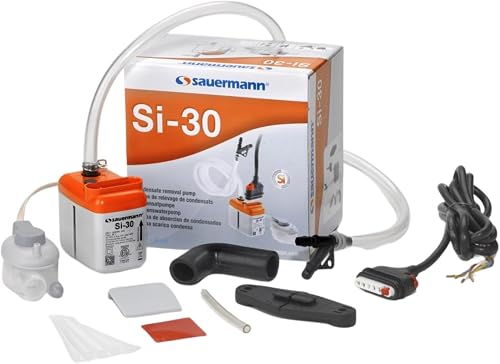 |  |  |  |  |  |  |
|---|---|---|---|---|---|---|---|---|---|---|
| Product | Aquastrong Mini Split Pump | Ultra Quiet Condensate Pump | Aspen Silent+ Mini Aqua | Sauermann Si-30 Pump | Rectorseal Ghost External | Compact Mini Split Pump | P16 Mini Split Pump | Universal Mini Split Pump | Soft Start Condensate Pump | Little Giant EC-1K-DV |
| Brand | AQUASTRONG | GuardFlow | Aspen Pumps | Sauermann | Rectorseal | GuardFlow | WIPCOOL | Cleartide | heculy | Little Giant |
| Best for | Best Overall | Best for High Lift | Best for Slim Units | — | Best for Tight Spaces | Best for Apartments | Best for Ductless Systems | — | — | — |
| The listing says | Max flow 9.6 GPH and 33ft head Thermally protected motor operates at 20 dB | Operates at 16 dB with soft-start technology Capacitive sensor replaces traditional float mechanism | Flow rate 9.25 GPH at 16 dB(A) Intelligent variable speed control technology | For AC units up to 5.6 tons (20 kW) 5 GPH max flow and 33 ft max lift | Variable-flow technology reduces noise Low profile design for tight spaces | Compatible with ductless and ducted HVAC Float switch controls automatic operation | 4.2 GPH flow and 33 ft max head Operates at less than 19 dB | Max flow 10.6 GPH and 33ft head Separated reservoir and motor design | Designed for mini split condensate removal Compact design for tight installation areas | 110 to 240 volt operation Includes noise reducer at 21 dB(A) |
| More information | Check Price on Amazon | Check Price on Amazon | Check Price on Amazon | Check Price on Amazon | Check Price on Amazon | Check Price on Amazon | Check Price on Amazon | Check Price on Amazon | Check Price on Amazon | Check Price on Amazon |
1. Aquastrong Mini Split HVAC Condensate Pump
Best for: Standard residential AC, furnace, and dehumidifier setups.
This pump features a thermally protected motor designed for silent 20 dB operation, making it ideal for bedrooms or home offices. The integrated hall switch ensures reliable, automatic operation. Its automatic safety switch allows you to wire the unit directly to your HVAC appliance. If the sensor detects high water levels, the switch triggers an automatic shutdown to prevent overflow.
Wire the NC and COM leads to your HVAC appliance to kill the power during a fault. Use the NO and COM leads if you prefer to trigger an external alarm instead. This distinction ensures you can choose between stopping a flood or simply being alerted to one.
The pump provides a 33-foot maximum lift. While sufficient for most homes, it isn’t for multi-story commercial buildings where vertical distances exceed this capacity. A maximum head of 33ft.
Installation is flexible due to the anti-vibration velcro strips, which allow for mounting in line set covers, wall cassettes, or above ceilings. Always install the reservoir vertically with the magnet facing upward. If the reservoir sits at an angle, the float may stick and fail to trigger the safety switch.
You must clean the reservoir, float, and filter at least every six months. Neglecting this maintenance leads to clogging, which eventually causes the pump to fail or overflow. The removable tank makes this process straightforward, but failing to keep to this schedule is the most common reason for premature pump failure.
Pros
- Includes automatic safety switch
- Ultra-silent 20 dB operation
- Easy-to-clean removable reservoir
Cons
- 33-foot maximum lift limit
- Requires manual cleaning every six months
2. Ultra Quiet Condensate Pump
Best for: High-lift requirements and quiet bedrooms.
This pump stands out with its 65.6-foot lift capacity and soft-start technology that minimizes vibration during operation. By using a capacitive sensor instead of a physical float, it avoids the mechanical sticking issues often found in older pump designs. This solid-state sensor detects water levels with digital precision, which prevents common leaks and extends the unit’s service life.
This unit uses a smart variable flow system that adjusts automatically between 5.3 and 10.6 GPH based on condensation levels. If your installation requires vertical water movement through ceilings or long drain lines, this pump is the right choice. However, it isn’t for those looking for a basic, low-complexity pump. The diagnostic LED features and intelligent calibration modes require more attention during setup than traditional mechanical models.
If you’re installing this in a noise-sensitive environment like a bedroom or home office, the 16 dB operation ensures a peaceful space. Always use the included spirit level gauge and drilling template to ensure a precise, professional fit. Because the unit features a 3A safety overflow switch, ensure it’s wired into your AC safety circuit. This provides a critical fail-safe that shuts down the system if a drainage issue occurs, preventing water damage.
Pros
- Powerful 65.6-foot vertical lift
- Advanced capacitive sensor technology
- Quiet 16 dB operation
Cons
- More complex setup process
- Requires careful initial calibration
3. Aspen Silent+ Mini Aqua Gen 5 Condensate Pump
Best for: Modern, high-capacity ductless systems.
The Gen 5 design of this pump offers a significant performance boost over older models, delivering nearly three times the flow rate. Its variable speed control is a standout feature, as it allows the pump to work only as hard as the current system demand requires.
While it shares the 16 dB noise rating with the Ultra Quiet Condensate Pump, this model focuses heavily on a “plug-and-play” experience for rapid maintenance. It isn’t for users with older, low-BTU units that might not benefit from the advanced variable speed technology.
Pros
- Intelligent variable speed control
- Near-silent 16 dB performance
- High 136,000 BTU compatibility
Cons
- Higher complexity for simple systems
- Specific maintenance cycles recommended
4. Sauermann Si-30 Mini Condensate Removal Pump
Best for: Professional-grade reliability and durability.
This pump uses patented piston technology that’s specifically designed to handle dirty condensate, which is a common cause of clogs in standard pumps. The inclusion of a “Drain Safe” device helps retain the pump’s prime, extending its overall service life in harsher environments. If your AC unit is rated up to 5.6 tons, this 230V unit provides the necessary capacity to manage condensate effectively.
The Sauermann Si-30 includes a mounting bracket. It isn’t for the casual DIYer who wants an all-in-one kit that fits inside every type of trunking without specific bracket configurations. If you’re mounting the pump above the unit, ensure you have the clearance for the 2.6 x 1.8 x 2.4 inch housing.
The pump operates at a quiet 20 dBA, and the anti-vibration bracket prevents noise transfer to your walls or pipework. Use the NC safety switch to automatically shut down the AC if an overflow occurs, protecting your interior from water damage.
Pros
- Patented clog-resistant piston
- Includes anti-vibration mounting bracket
- Independently tested sound levels
Cons
- Fixed bracket installation style
- 5 GPH flow limit
5. Rectorseal Ghost External Plus Mini Split Condensate Pump Kit 100-240V
Best for: External wall-mounted installations.
The low-profile design of this pump makes it perfect for tight spots where you can’t fit a pump inside the unit itself. Because the mounting is reversible, you have extra flexibility to place it on either the left or right side of your wall-mounted unit. Use this model when you need to fit the pump neatly beneath a high-wall unit or directly above a doorway.
Compared to the Aquastrong Mini Split Pump, this unit is specifically built for external mounting, making it a cleaner look for finished rooms. It isn’t for users who prefer a completely hidden installation inside the wall or ceiling cavity. If your installation space is restricted, the compact footprint allows for a professional finish without needing internal access.
Smart flow control automatically adjusts the pump speed based on condensate levels. This adaptive technology ensures the unit only works as hard as necessary. If you notice the system running constantly, check your condensate levels; the pump should cycle smoothly rather than staying at maximum output.
Integrated NC/NO safety contacts protect your HVAC equipment by shutting down the system if water levels rise too high. Always wire these contacts into your unit’s control circuit.
Pros
- Low-profile, sleek design
- Reversible mounting orientation
- Integrated safety contacts
Cons
- External placement is visible
- Limited to specific mounting areas
6. Compact Mini Split Pump
Best for: Tight spaces in residential apartments.
This pump is built with a fully potted motor, which provides extra resistance against the moisture and vibration often found in small, enclosed HVAC spaces. Its compact dimensions make it an easy fit for tight attic or basement installations where space is at a premium.
While it’s very compact, its 20 dB noise rating is slightly higher than the Ultra Quiet Condensate Pump. It isn’t for users who need a high-flow commercial-grade pump, as this model is specifically engineered for residential and light commercial use.
If you’re installing in a bedroom or home office, prioritize the vibration-dampening mounting to keep noise at the 20 dB floor. If the pump is in a basement or garage, you can focus more on the 3A safety switch, which triggers an automatic system shutdown if a blockage occurs. Always wire this safety circuit into your AC unit to prevent water damage.
Many users make the mistake of ignoring the anti-siphon valve. If your discharge line runs vertically, you must install this valve to prevent backflow, which would otherwise force the pump to cycle constantly.
Pros
- Fully potted moisture-resistant motor
- Highly compact split-style design
- Includes complete accessory kit
Cons
- Slightly louder than premium models
- Basic float switch operation
7. P16 Mini Split HVAC Condensate Pump
Best for: Concealed fan coil and ducted systems.
This pump uses a probe-based system rather than a mechanical float to detect water levels. This design choice removes common mechanical failure points, making it a reliable choice for tight ceiling spaces where you might not have easy access for frequent maintenance.
Compared to the Universal Mini Split Pump, this unit is optimized for ducted HVAC, offering a very quiet 19 dB operation. If you’re installing in a bedroom, office, or sound-sensitive living space, this low decibel rating prevents the intrusive noise typical of standard pumps.
The pump delivers a 4.2 GPH flow rate with a 33 ft maximum discharge head. When properly connected to your system’s control board via the NC safety output, the probe detects abnormal water levels and triggers a shutoff signal. This feature is vital to prevent water overflow damage in your ceiling.
Pros
- Reliable water level probe
- Very quiet 19 dB operation
- Designed for tight ceilings
Cons
- Requires periodic cleaning
- Less ideal for wall units
To ensure long-term performance, clean the pump tank, float, and filter basket every 3 to 6 months. Skipping this maintenance schedule often leads to debris buildup, which can obstruct the probe and cause the pump to fail during peak seasonal usage.
8. Universal Mini Split Pump
Best for: Quick, straightforward installation.
This pump comes with everything you need right in the box, including velcro strips for vibration dampening and various adapters for different hose sizes. The separation of the reservoir and motor makes it easier to place the components in cramped spaces, such as inside line set covers or above ceilings.
It’s a great alternative to the Aspen Silent+ Mini Aqua if you want a simple, effective solution without the high-end variable speed electronics. Use this model when you have a standard residential unit, as its 10.6 GPH capacity is calibrated for typical home air conditioning, furnaces, or dehumidifiers. If your system produces massive amounts of water, verify your flow requirements first, as this pump is designed for efficiency in small-space applications rather than industrial-scale removal.
A common mistake is failing to clean the reservoir periodically. Because the tank and filter are transparent, you should visually inspect them every few months. If you see debris, remove the tank to clear the blockage before the overflow safety switch triggers a system shutdown.
Pros
- Complete accessory kit included
- Easy-to-install split design
- Reliable hall switch operation
Cons
- 23 dB noise level
- Standard mechanical design
9. Soft Start Condensate Pump
Best for: Noise-sensitive living spaces.
The soft-start feature on this pump is its main advantage, as it eliminates the sudden “thump” or vibration that can occur when a motor kicks on. This makes it a strong contender for bedrooms or quiet home offices where any sudden noise could be disruptive.
If you’re installing this in a tight space, the compact build allows for a quick connection with minimal effort. You should choose this model if your priority is a space-saving design that fits into cramped wall cavities. Because it’s built to handle continuous drainage, it effectively prevents water buildup and potential damage to your system.
While it offers a very smooth operation, it lacks some of the advanced monitoring features found in the Ultra Quiet Condensate Pump. It isn’t for users who want to see diagnostic LED lights or complex status feedback from their drainage system. If you require real-time alerts or system health reports, you should look for a more sophisticated unit. Otherwise, this pump provides efficient, reliable performance for most standard mini split air conditioning systems.
Pros
- Soft-start motor technology
- Space-saving compact build
- Quiet, continuous drainage
Cons
- Fewer diagnostic features
- Basic monitoring capabilities
10. Little Giant EC-1K-DV 110-240V
Best for: A complete, all-in-one kit.
This kit is unique because it includes a trim set that gives the pump a finished, professional look once installed on the wall. It’s designed to work with both 3/8-inch and 5/8-inch line sets, making it a highly compatible choice for many different AC models.
Unlike the Rectorseal Ghost External, this kit includes a full line set cover, providing a clean, aesthetic installation. It isn’t for users who just need the pump itself, as the inclusion of the line set kit makes it a more substantial purchase than a standalone pump.
You must decide between right or left-side installation before mounting the bracket. If you’re mounting on a wall where space is limited, remember the enclosure requires room for the 2.1-inch by 3.0-inch line set dimensions.
The system operates at 21 dB(A), making it quiet enough for bedrooms or offices. However, ensure your power source is ready for hard-wiring, as the unit requires a direct connection rather than a standard plug. The unit provides enough vertical pressure to clear water across significant distances and maintains a reliable suction lift for standard drainage needs. Always verify your total lift before installation to avoid drainage backups.
Pros
- Includes line set trim kit
- Universal 110-240V compatibility
- Professional aesthetic finish
Cons
- More parts to install
- Heavier, bulkier package
How to Choose in Sixty Seconds
Verify Your Lift Requirements
Before you buy, measure the vertical distance from the pump to the highest point of your drain line. If your drain line goes up into a ceiling or attic, you must exceed this vertical height with your pump’s maximum head capacity. Always check the Underwriters Laboratories safety standards for HVAC equipment to ensure your chosen pump meets the necessary electrical and environmental certifications for your region. A pump that’s underpowered will struggle to clear the water, eventually leading to overflow and potential damage to your walls or flooring.
Consider Noise Sensitivity
If your indoor unit is in a bedroom or a quiet office, the decibel rating is just as important as the flow rate. Look for pumps rated at or below 20 dB, as these are generally considered whisper-quiet. Variable speed pumps, like those from Aspen Pumps, often run quieter because they don’t always operate at full power. Remember that vibration is a major source of noise; pumps that include anti-vibration velcro or rubberized mounting brackets will always be quieter than those mounted directly to a hard surface. If the pump is going into a basement or garage, you can be more flexible with the noise level.
Evaluate Sensor Technology
Modern pumps usually come with either a mechanical float switch or a capacitive sensor. Mechanical floats are traditional and easy to understand, but the moving parts can sometimes stick if they get dirty or clogged with algae. Capacitive sensors, found in newer models like the GuardFlow or Aspen units, have no moving parts. If you live in an area with high humidity, your pump will work more often, making a capacitive sensor a better investment. Regardless of the sensor type, you must commit to cleaning the reservoir and filter on a regular seasonal schedule to prevent buildup.
The Aquastrong Mini Split Pump and Ultra Quiet Condensate Pump remain our top picks for performance and quiet operation. Before installation, confirm your tubing size and voltage requirements. Always follow the manufacturer’s guide to maintain your warranty and ensure the safety switch is wired correctly. Schedule a professional inspection next season to ensure long-term reliability.
Related guides