
Selecting the right clear vinyl tubing for an air conditioning system depends on matching the hose diameter to your specific drainage or pump setup. While most options share similar flexible PVC construction, they differ significantly in length, wall thickness, and suitability for potable water applications.
Best overall: Eastman 1/2 Inch Tubing provides a versatile, FDA-compliant solution for standard plumbing and drainage needs that balances flexibility with a reliable wall thickness for most home projects.
Best for long runs: DAVCO 1/2 Inch Tubing offers a substantial 50-foot length and enhanced wall thickness, making it ideal for professional or extensive home installations where you can’t afford a collapse.
Best for condensate pumps: PVC Condensate Pump Tubing features a specialized 3/8-inch inner diameter and industrial-grade construction, specifically engineered to withstand the unique pressures and environments of AC condensate systems.
The rest of this guide is for homeowners and DIY enthusiasts looking to replace or install new drainage lines for their cooling equipment.
How We Picked
We compared 16 different clear vinyl tubing listings to identify the most reliable options for air conditioning and general drainage use. Our selection focused on products that clearly stated their inner diameter, outer diameter, wall thickness, and working pressure ratings. We prioritized listings that provided specific temperature ranges and material certifications, such as FDA compliance or BPA-free status, to ensure the tubing could handle the intended environment. Products were excluded if they lacked essential dimension data or if their primary application was strictly incompatible with common AC drainage setups.
All 10 products side by side — scroll sideways to see every column.
| Top Pick | Best for Long Runs | Best for Sediment | Best for Flexibility | Best for Condensate Pumps | Best for Tight Spaces | Best for Laboratory | Best for Small Lines | |||
| Preview | 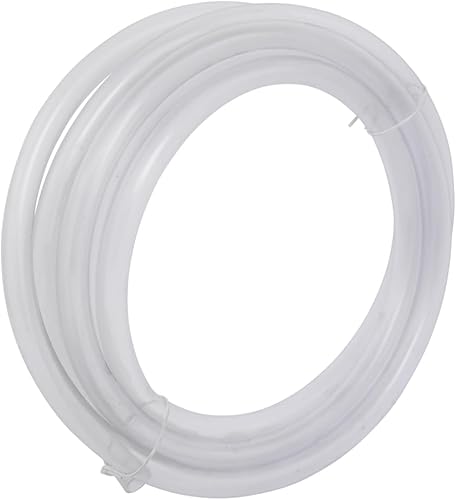 |  |  |  |  |  |  |  |  |  |
|---|---|---|---|---|---|---|---|---|---|---|
| Product | Eastman 1/2 Inch Tubing | DAVCO 1/2 Inch Tubing | DERNORD 3/8 Inch Tubing | Clear Vinyl 1/2 Inch | Watts 5/8 Inch Tubing | PVC Condensate Pump Tubing | Hybrid PVC 1/4 Inch | Valterra 3/8 Inch Tubing | U.S. Solid 3/4 Inch | uxcell 4mm PVC Tubing |
| Brand | Eastman | DAVCO | DERNORD | Geowaky | Watts | Cleartide | PLUMBINGMASTER | Valterra | U.S. Solid | uxcell |
| Best for | Best Overall | Best for Long Runs | Best for Sediment | — | Best for Flexibility | Best for Condensate Pumps | Best for Tight Spaces | — | Best for Laboratory | Best for Small Lines |
| The listing says | Handles liquids, chemicals, and gases For drainage, water, and lab use | 1/2 inch ID, 5/8 inch OD, 50 feet 60 PSI max working pressure | 3/8 inch ID x 1/2 inch OD, 100 Feet For liquid and semi-solid conveyance | Non-toxic and BPA free PVC 1/2 inch ID x 5/8 inch OD, 10 feet | Pre-cut clear vinyl tubing 5/8-Inch OD x 1/2-Inch ID, 10 foot length | Resistant to abrasion, oil, and corrosion Flexible and kink-resistant design | Made from premium PVC material Temperature -5°C to 65°C, 60 PSI | Flexible and non-toxic Corrosion resistant | For liquids, chemicals, and gases For drainage and laboratory use | Resistant to abrasion and corrosion 0.15-inches ID, 0.23-inches OD, 9.8-feet |
| More information | Check Latest Price on Amazon | Check Latest Price on Amazon | Check Latest Price on Amazon | Check Latest Price on Amazon | Check Latest Price on Amazon | Check Latest Price on Amazon | Check Latest Price on Amazon | Check Latest Price on Amazon | Check Latest Price on Amazon | Check Latest Price on Amazon |
1. Eastman 1/2 Inch ID (5/8 Inch OD) PVC Clear Vinyl
Best for: General home plumbing and drainage projects.
This tubing is made from FDA-compliant PVC, making it a safe choice for various liquid transfers. The 1/16-inch wall thickness provides enough structure to handle pressures between 19 and 55 PSI. This range is suitable for standard gravity-fed drainage lines, aquarium setups, and beverage dispensers.
Because it’s flexible, you can easily route it through tight spaces in your home. Use this for low-pressure transfer or flow control where you need to see the liquid moving. If your application involves high-pressure supply lines, look for reinforced tubing instead, as this PVC can collapse or burst under extreme strain.
It isn’t recommended for ice maker supply lines. The material is designed for specific low-pressure environments, and ice makers often subject lines to higher pressure cycles that exceed the 55 PSI limit. If you need a longer, continuous run for a larger project, consider the DAVCO 1/2 Inch Tubing instead.
Measure your space before cutting, as the 10-foot length is fixed. You can trim it to size with standard shears for a custom fit in DIY or professional plumbing setups.
Pros
- FDA-compliant PVC material
- Easy to cut to size
- Suitable for potable water
- Flexible for tight installs
Cons
- Not for ice makers
- Limited 10-foot length
- Maximum temperature of 170 degrees F
2. DAVCO 1/2″ ID x 50ft Clear Vinyl Tubing
Best for: Large-scale installations requiring long hoses.
The 50-foot length means you won’t run out of material during a complex AC drainage job. It features professional wall thickness enhancement technology, which helps it resist kinking and collapsing under pressure. While the tubing fits most standard barb fittings, you must use clips to ensure the connection remains secure and doesn’t slip off during operation.
If your application involves transferring chemicals, solvents, alkalis, or acids, this tubing is the correct choice due to its chemical-resistant vinyl construction. However, if your environment consistently exceeds 149℉ or drops below 23℉, this material will fail to maintain its structural integrity. You should also avoid using this tubing for systems exceeding 60 PSI, as the low-pressure design isn’t rated for high-pressure industrial lines.
Compared to shorter options, this model is built for heavy-duty, long-term use in home and industrial settings. Because it’s transparent, you can easily monitor the internal flow to detect blockages or debris before they cause a total system failure.
Pros
- Substantial 50-foot length
- Enhanced wall thickness
- Kink-resistant design
- High pressure rating
Cons
- May be too long for small jobs
- Requires clips for security
3. DERNORD PVC Tubing 3/8″ID X 1/2″OD Flexible Clear Vinyl Hose
Best for: Food-grade fluid transfer applications.
This tubing is BPA-free and non-toxic, making it a safe choice for beverage dispensing or potable water lines. The smooth interior and exterior surfaces prevent sediment accumulation, which maintains consistent flow and simplifies cleaning. Because the material is lightweight and flexible, it remains easy to maneuver during installation.
If your project involves conveying liquids or semi-solids, confirm your barbed fittings match the 3/8-inch inner diameter and 1/2-inch outer diameter. While this hose handles up to 60 PSI, avoid using it in high-pressure systems that exceed this limit, as the vinyl could fail.
Choose this tubing when your priority is food-grade safety and chemical resistance against alkalis or solvents. If you require a larger flow capacity, this 3/8-inch model may be too restrictive for your needs. Always verify your specific pressure requirements before installation to ensure the hose remains durable.
Pros
- BPA-free and non-toxic
- Smooth interior reduces sediment
- High 60 PSI rating
- 100-foot length available
Cons
- Smaller diameter than standard
- Not for high-pressure systems
4. Clear Vinyl 1/2 Inch
Best for: High-pressure transfer needs.
With a working pressure rating of 60 PSI and a firm 73A hardness, this tubing is built to withstand demanding environments. The thick 1.5mm walls prevent kinking, allowing you to unroll and route the hose without it collapsing.
This hybrid reinforced design resists alcohol, weak acids, and alkalis. It’s ideal for transferring liquids or gases in industrial equipment, humidifiers, or drainage systems. Because the interior is smooth, it prevents sediment accumulation, making it a reliable choice for long-term water or air transfer.
If your project requires a smaller diameter, the uxcell 4mm PVC Tubing might be a better fit for your specific pneumatic lines. Always verify your flow requirements against the 60 PSI limit, as exceeding this pressure may cause the tubing to fail.
Pros
- High 60 PSI pressure rating
- Kink-proof design
- Durable hybrid PVC construction
- Smooth interior surface
Cons
- Firm 73A hardness reduces flexibility
- Limited 10-foot length per segment
5. Watts SVKI10 Pre-Cut 5/8-Inch Diameter by 1/2-Inch Clear Vinyl Tubing
Best for: Pre-cut, ready-to-use projects.
This tubing is manufactured to specific standards that mimic the clarity of glass while maintaining the flexibility of rubber. It’s an excellent choice for those who need a quick, reliable pre-cut section without having to measure and cut from a bulk roll.
Check your specific diameter requirements before starting. This product features a 5/8-inch outside diameter and a 1/2-inch inside diameter. If your application involves high-pressure fluid transfer, remember that this vinyl material is designed for general chemical, gas, and liquid handling rather than pressurized systems.
It handles a wide range of chemicals and liquids, including acids, alkalis, and many solvents. However, you must avoid using it for ice maker connections. If your project requires installation near heat sources or in environments with extreme chemical exposure, look for industrial-grade alternatives that offer higher temperature thresholds. For a more industrial-grade option, the PVC Condensate Pump Tubing offers better resistance to harsh workshop conditions.
Pros
- High-clarity material
- Flexible and easy to route
- Convenient pre-cut length
- Acid and alkali resistant
Cons
- Not for ice makers
- Fixed length only
6. PVC Condensate Pump Tubing
Best for: AC condensate drainage lines.
This tubing features industrial-grade PVC construction that resists abrasion, oil, and chemical corrosion. The 20-foot length provides enough material for most standard AC installations while allowing for easy cutting to fit tight spaces.
The material is soft yet sturdy, ensuring it routes through your equipment without collapsing or restricting flow. If you need a larger diameter for a main drain line, the U.S. Solid 3/4 Inch is a more appropriate choice. Always verify your pump outlet size first. This tubing is precision extruded with a 3/8-inch inner diameter and a 1/2-inch outer diameter. Using the wrong size will cause leaks at the connection point.
You can rely on this hose for temperatures ranging from 23°F to 140°F. If your environment frequently drops below freezing, consider a reinforced hose to prevent brittle cracking. While this tubing is ideal for air compressor lines, aquarium water changes, and hydroponic systems, it isn’t rated for potable water.
Pros
- Industrial-grade chemical resistance
- Kink-resistant and flexible
- Consistent 3/8-inch inner diameter
- Includes 20-foot roll
Cons
- Specific diameter limits use
- Not for potable water
7. 10ft 1/4”ID×3/8”OD Clear Vinyl Tubing Flexible and Hybrid PVC Tubing
Best for: Tight, small-scale fluid transfer.
This hybrid PVC tubing is designed for precision, featuring a 1/4-inch inner diameter that works well in confined areas. It’s leak-proof and corrosion-resistant, making it a reliable choice for laboratory or AC field applications where space is limited.
The tubing handles temperatures between 23°F and 149°F. If your system exceeds 60 PSI, this material will fail; use reinforced alternatives for high-pressure lines. Always verify your connection points, as the 3/8-inch outer diameter requires specific fittings to prevent leaks.
The manufacturer provides a 10-year warranty, which ensures long-term reliability for your installations. If you require a larger hose for high-flow drainage, consider the Eastman alternative instead.
Pros
- 10-year manufacturer warranty
- Corrosion-resistant material
- Precise 1/4-inch diameter
- Easy to install
Cons
- Very small diameter
- Low flow capacity
- 60 PSI pressure limit
8. Valterra W01-1400BU Clear Vinyl Tubing
Best for: Bulk industrial or hobbyist needs.
This 100-foot bulk roll serves users who perform frequent installations or manage large-scale projects requiring many small sections of tubing. Because the material is NSF-listed, you can safely use it for sensitive applications where purity matters.
The tubing remains flexible and resistant to corrosion, maintaining its shape well during routine use. If your setup requires a rigid, high-pressure line, choose the Clear Vinyl alternative instead. This 3/8-inch vinyl is designed for flexibility, not for containing forceful liquid flow.
When deciding between sizes, check your system’s pressure rating first. If the pressure exceeds standard gravity-fed or low-flow requirements, this tubing will likely kink or fail. You should also account for the weight of the full 100-foot roll. It’s substantial, so ensure your storage area can support the bulk before purchasing.
Pros
- Large 100-foot bulk length
- NSF-listed materials
- Corrosion-resistant
- Highly flexible
Cons
- Large roll is heavy
- Not for high-pressure systems
9. U.S. Solid Clear Vinyl Tubing
Best for: Large-diameter drainage applications.
When your project requires high flow rates, this 3/4-inch inner diameter tubing is the most capable option on the list. It’s constructed to be resistant to both abrasion and kinking, ensuring a long service life even in demanding pneumatic or drainage systems.
It handles pressure up to 72.5 PSI, which is higher than most other options here. If your system exceeds this pressure rating, you must choose a different material to avoid catastrophic failure. Always verify your pump output before installation.
Note that this isn’t recommended for potable water, so keep it strictly for drainage, aquarium air lines, or industrial use. If you need to transport drinking water, look for materials specifically certified for that purpose.
You can easily cut this 19.69-foot length to fit your specific setup. It performs reliably within a temperature range of -4°F to 140°F. If you operate outside these thermal limits, the PVC may lose its flexibility or structural integrity.
Pros
- Large 3/4-inch inner diameter
- High 72.5 PSI pressure rating
- Kink-resistant construction
- Suitable for gas transfer
Cons
- Not for potable water
- Large size is bulky
10. uxcell 4mm PVC Tubing
Best for: Micro-tubing pneumatic or small-scale automation.
This tubing is designed for small-scale industrial applications, such as factory air lines or automation machinery. It’s highly resistant to corrosion and abrasions, and the thin 0.04-inch walls allow for higher flow rates relative to its 0.15-inch internal diameter.
Because it’s made of clear PVC, you can easily monitor the internal flow. The material is lightweight and flexible, meaning twists and curves won’t cause the tubing to collapse.
Use this product if your setup requires the conveyance of chemicals, liquids, or gases in a low-pressure industrial environment. If you’re working with granular solids, ensure the particle size is suitable for the 4mm opening to prevent clogs.
The manufacturer explicitly notes it has a plastic taste and isn’t suitable for food or drinking water use. Avoid using this tubing for any application involving human consumption, as the material is strictly intended for industrial, pneumatic, or mechanical purposes.
Pros
- Ideal for micro-applications
- Abrasion and corrosion resistant
- Easy to monitor flow
- Flexible for tight curves
Cons
- Not for food use
- Very low capacity
How to Choose in Sixty Seconds
Verify Your Dimensions
The most critical step is confirming the inner diameter (ID) of your fittings. Tubing is measured by its ID and outer diameter (OD). If your barb fitting is 1/2 inch, you must buy 1/2-inch ID tubing. Buying the wrong size will lead to leaks or a failure to connect entirely. Always check the specific specs of your pump or drain outlet before ordering. If you’re unsure, measure the existing hose with a caliper or ruler. Don’t guess based on visuals alone, as a difference of even 1/8 inch will make the hose either too loose to seal or impossible to slide onto the fitting.
Assess Your Environment
Determine if your tubing will be exposed to chemicals, extreme temperatures, or food-grade requirements. For instance, the FDA Code of Federal Regulations outlines specific standards for materials used in food-contact applications. If your AC drain line is near a kitchen or potable water source, always select a model labeled as BPA-free or FDA-compliant. If the tubing will be used in an industrial setting with oil or harsh cleaners, look for the chemical resistance ratings mentioned in the product descriptions. Never use standard vinyl tubing for high-heat environments unless the listing explicitly states it can handle your specific temperature range.
Consider Installation Needs
Think about how much tubing you actually need and how it will be routed. If you’re running a line through a wall or attic, a kink-resistant or “heavy-duty” model is essential to prevent flow restrictions. If you have multiple small projects, a longer roll provides enough material for several segments. However, remember that long, heavy rolls are harder to store. Always ensure you have the correct clamps if the manufacturer suggests them for a secure fit.
The Eastman tubing remains our top choice for most home AC drainage tasks due to its balanced specifications and flexibility. For those requiring longer runs for professional installations, the DAVCO tubing provides the necessary durability and length to get the job done right. Before you begin your installation, double-check that you have the correct barb fittings and hose clamps to ensure a watertight seal. The listing doesn’t mention specific pump outlet compatibility. Once you have confirmed your measurements, you’re ready to complete your project with confidence.
Frequently Asked Questions
Can I use this tubing for my ice maker?
Standard clear vinyl tubing is not recommended for ice maker supply lines. These applications require specific, rigid, or braided materials to withstand high pressure and prevent contamination. Always use tubing explicitly labeled for ice maker use to avoid leaks and ensure water safety.
How do I stop the tubing from kinking?
Kinking occurs when the wall thickness is insufficient for the bend radius or when the material becomes too soft under heat. To prevent this, choose a model with “heavy-duty” or “reinforced” wall construction, like the Clear Vinyl or DAVCO options. Always ensure the hose path is as straight as possible to maintain consistent flow.
Is clear vinyl tubing safe for drinking water?
Only use tubing labeled as “potable water safe,” “BPA-free,” or “FDA-compliant” for drinking water. Products like the Eastman 1/2 Inch and DERNORD 3/8 Inch tubing meet these safety standards. Industrial or condensate-specific tubing may contain additives not tested for human consumption, so always verify safety certifications before use.
How do I connect the tubing to my pump?
The most secure way to connect tubing is by using a barb fitting and a hose clamp. The clamp tightens over the tubing and barb to prevent slippage, a method recommended for the DAVCO 1/2 Inch Tubing. If the tubing is too stiff, soak the end in hot water to soften it.
Conclusion
Once your new hose is securely in place, keep a close eye on the connection for the first few hours to ensure there aren’t any leaks. It’s also a good idea to check the flow every season, as preventing clogs early on will save you from bigger headaches down the road.