
Choosing the right condensate pump safety switch comes down to matching the electrical needs of your HVAC system with the physical space you have available. While most units perform the same basic task of moving water, the primary differences lie in lift height, tank capacity, and whether they operate on standard or high-voltage power.
Best overall: Beckett BK171UL Condensate Pump offers a reliable 17 ft lift and a generous 2.5 quart tank, making it a versatile choice for most residential air conditioning and furnace setups.
Most reliable performance: LCU Series Condensate Pump provides a high-impact ABS tank construction and a proven design that focuses on durability for those who want a pump that’s built to last.
Best for heavy duty: Superior Pump 97202 features an impressive 21 ft max head and a dual-function safety switch, which is ideal for demanding environments where you need extra vertical pumping power.
This guide is for homeowners and DIY installers looking to prevent water damage from HVAC condensate overflow.
How We Picked
We compared 16 different automatic condensate pump listings to find the most capable options for residential and commercial HVAC drainage. To earn a spot in this article, each product had to clearly state its maximum lift capacity, tank volume, and the specific safety switch configuration it uses.
All 10 products side by side — scroll sideways to see every column.
| Top Pick | Runner-Up | Best for High Lift | Best for Flame Resistance | Best for Mini Splits | Best for Living Areas | Best for Commercial Use | Best for Flexible Voltage | Best for Home Maintenance | ||
| Preview | 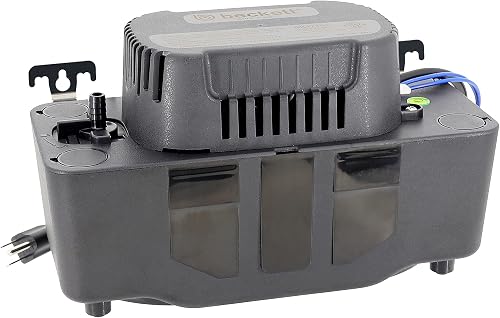 |  |  |  |  |  |  | |  |  |
|---|---|---|---|---|---|---|---|---|---|---|
| Product | Beckett BK171UL Condensate Pump | LCU Series Condensate Pump | Superior Pump 97202 | Liberty Pumps LCU-20ST | HVAC Premium Tank Pump | Mini Split HVAC Pump | 110V 95GPH Condensate Pump | Beckett BK222UL Condensate Pump | WATNOVA HVAC Condensate Pump | Automatic Condensate Removal Pump |
| Brand | Beckett | Liberty Pumps | Superior Pump | Not stated | HVAC Premium | Cleartide | BPSSDI | Beckett | WATNOVA | KYDEVO |
| Best for | Best Overall | Runner-Up | Best for High Lift | — | Best for Flame Resistance | Best for Mini Splits | Best for Living Areas | Best for Commercial Use | Best for Flexible Voltage | Best for Home Maintenance |
| The listing says | Automatic on/off operation Includes mounting brackets and check valve | High impact ABS tank Three intake holes | 1/30 HP 115 Volt motor 108 gallons per hour, 21 feet head | High impact ABS tank Three intake holes | Automatic HVAC condensate removal Flame retardant ABS and metal construction | 10.6 GPH flow, 33ft max head Separated reservoir and motor design | Automatic operation and drainage 1.9Qt water tank, 380Qt flow rate | Automatic on/off operation Includes mounting brackets and check valve | 95 GPH flow, 25 ft lift ETL listed for safety | 1/30 HP motor, 80 GPH flow Built-in overflow safety switch |
| More information | Price on Amazon | Price on Amazon | Price on Amazon | Price on Amazon | Price on Amazon | Price on Amazon | Price on Amazon | Price on Amazon | Price on Amazon | Price on Amazon |
1. Beckett BK171UL Condensate Pump with Safety Switch
Best for: Standard residential HVAC systems and dehumidifiers.
The Beckett BK171UL Condensate Pump stands out because of its large 2.5 quart collection tank, which reduces the frequency of pump cycles. The inclusion of a bullseye level on the lid makes it much easier to ensure the unit sits flat during setup, preventing air locks or uneven drainage. It’s designed to handle temperatures up to 150° F, which is a key advantage if you’re connecting it to high-efficiency furnaces that produce hot, acidic water.
Pros
- Large 2.5 quart capacity tank
- Integrated bullseye leveling gauge
- Handles temperatures up to 150° F
Cons
- Larger footprint than compact models
2. LCU Series 115V Condensate Removal Pump with Safety Switch
Best for: Users needing a straightforward, durable replacement pump.
The LCU Series Condensate Pump is built with a high-impact ABS tank, which is designed to withstand the vibrations and moisture common in HVAC environments. It features three intake holes, giving you more flexibility when routing your drain lines from different pieces of equipment. The removable check valve is a helpful addition for maintenance, as it allows you to clear potential clogs without removing the entire pump assembly.
This unit includes both barbed and threaded discharge connections. This dual-option design allows you to secure your tubing using either a standard hose clamp or a threaded fitting, depending on your existing setup. Such versatility simplifies the installation process significantly.
Compared to the Superior Pump 97202, this model is more focused on basic, reliable operation rather than high-lift performance.
Pros
- Durable high-impact ABS construction
- Three separate intake ports
- Removable check valve for cleaning
- Dual-style discharge connection
Cons
- Lower lift capacity than heavy-duty models
- No specialized mounting hardware included
3. Superior Pump 97202
Best for: Systems requiring high vertical lift.
The Superior Pump 97202 is designed for challenging drainage scenarios, boasting a 21 ft maximum head capacity. Its dual-function safety switch allows for both normally open and normally closed wiring, making it compatible with a wider range of HVAC furnace or air conditioner control boards. The 1/30 HP thermally protected motor is built for consistent performance, and the four inlet openings provide plenty of options for multi-unit drainage.
This unit excels when your drain line must travel significantly upward before exiting the building. Because the pump can move up to 108 gallons per hour, it handles high-volume condensate production without stalling. The stainless steel motor shaft and fan-cooled design ensure the internal components survive the heat of a furnace environment or the humidity of a basement dehumidifier.
If you have a standard setup with minimal vertical distance, this pump may be overkill. A smaller model often provides a simpler installation experience for low-drainage setups where such extreme lift capacity is unnecessary.
Pros
- High 21 ft vertical lift
- Dual-function safety switch wiring
- Four inlet openings for versatility
Cons
- Requires careful wiring for safety switch
- Larger size than entry-level pumps
4. Liberty Pumps LCU-20ST Automatic 1/30 HP Compact Condensate Pumps
Best for: Compact installations with limited clearance.
The Liberty Pumps LCU-20ST is a compact solution for those who struggle with tight installation spaces. Its design focuses on simplicity, using a high-impact ABS tank that resists corrosion and wear. The package includes 20 feet of tubing, which is a major convenience for installers who don’t want to purchase additional drainage lines separately.
You gain flexibility during setup because the unit features three intake holes. This allows you to position the pump in the orientation that best suits your existing plumbing layout. The discharge connection is both barbed and threaded, ensuring a secure grip on your tubing regardless of the fitting style you prefer. A removable check valve is also included, which simplifies maintenance when you eventually need to clean the system or clear a blockage.
Pros
- Includes 20 feet of tubing
- Compact, space-saving design
- Corrosion-resistant ABS tank
Cons
- Limited capacity for heavy loads
- Smaller tank requires frequent cycling
5. HVAC Premium Condensate Removal Pump
Best for: Simple, fast installation.
The HVAC Premium Tank Pump is designed for ease of use, featuring flame-retardant materials for both the tank and the motor cover. It’s compatible with various HVAC systems, including floor-standing and cassette units, which makes it a flexible choice for residential upgrades. The automatic safety switch is a key feature, as it can be wired directly to an alarm to prevent water damage from overflow.
This unit excels in environments where you need to collect and remove condensate from furnaces, dehumidifiers, or condensing boilers. Because the motor shaft and tank cover use high-quality flame-retardant metal, the pump resists corrosion. This durability ensures the internal components remain protected even in damp conditions.
If you’re looking for more advanced lift specifications, the Superior Pump 97202 offers greater vertical reach.
Pros
- Flame-retardant ABS plastic construction
- Versatile mounting for multiple unit types
- Integrated safety switch for alarms
Cons
- Standard lift capacity only
- No additional tubing included
6. Mini Split HVAC Pump
Best for: Mini split air conditioning systems.
The Mini Split HVAC Pump features a unique design where the reservoir and motor are separated, connected only by a signal wire. This layout is ideal for ceilings or wall cassettes where space is extremely limited. You can tuck the components into tight line set covers or above drop ceilings where a traditional bulky tank pump would never fit.
With a 33 ft max head, it significantly outperforms many standard tank pumps in terms of vertical reach. It also operates at a whisper-quiet 23 dB, making it the best choice if your indoor unit is located in a bedroom or quiet living area. The system includes an automatic hall switch and an overflow safety wire that shuts down the unit if a clog occurs, preventing water damage.
Unlike the Beckett BK171UL Condensate Pump, this unit isn’t intended for high-volume furnace drainage. It’s a specialized tool for mini split refrigeration units and small-space air conditioning.
Pros
- Separated motor and reservoir for tight spaces
- Extremely quiet 23 dB operation
- High 33 ft vertical lift
Cons
- Requires specific mini split installation
- More complex wiring setup
7. 110V 95GPH HVAC Condensate Pump
Best for: Quiet operation in living areas.
The 110V 95GPH Condensate Pump is designed for noise-sensitive environments, operating at just 29 dB. Its 1.9 quart tank is a good middle-ground for standard HVAC systems, and the 19.6 ft lift is sufficient for most residential basement or attic furnace installations. It features shock-absorbing feet that help reduce vibration, making it a great choice if the pump is located near a bedroom or living space.
The pump uses a probe-based system to trigger automatic drainage once the water level reaches capacity. This ensures the unit only runs when necessary, which saves energy and prevents overflow. Ventilation holes are built into the housing to assist with heat dissipation, further protecting the internal components during extended operation.
This pump doesn’t come with a pre-installed plug, which is an important trade-off compared to other models. It isn’t for users who want a “plug and play” experience without electrical work. You’ll need to wire the power connection yourself to integrate it with your commercial ice maker, boiler, or furnace.
Pros
- Very quiet 29 dB performance
- Large 1.9 quart water tank
- 19.6 ft vertical lift capability
Cons
- Power plug not included
- Requires electrical connection setup
8. Beckett BK222UL Condensate Pump with Safety Switch
Best for: High-voltage residential or light commercial systems.
The Beckett BK222UL Condensate Pump is the high-voltage version of the Beckett line, operating at 230V. It offers a powerful 22 ft max lift and a 156 GPH flow rate, which is perfect for larger systems that generate more condensate. Like its 115V counterpart, it includes a bullseye level and a thermally protected motor for long-term reliability in demanding conditions.
The pump is specifically engineered to handle the acidic condensate often produced by high-efficiency oil or gas-fired furnaces. Its oversized collection tank is larger than many standard models, allowing the unit to pump more water per cycle and reducing the frequency of motor starts.
For a standard 115V household outlet, this pump isn’t the right choice. It’s intended specifically for systems wired for 230V, which are common in larger homes or professional HVAC setups. Always verify your equipment’s voltage requirements before purchase, as this unit won’t function on a standard residential circuit.
Pros
- High 22 ft max lift
- 230V power for heavy systems
- Includes bullseye leveling gauge
Cons
- Not for standard 115V outlets
9. WATNOVA HVAC Condensate Pump
Best for: Flexible voltage installations.
The WATNOVA HVAC Condensate Pump is highly versatile because it supports 100–240V power. This range allows it to function across diverse residential or light commercial electrical configurations without needing specialized adapters. It provides a 25 ft lift and comes with 20 ft of tubing, saving you the time and expense of sourcing compatible drain lines separately.
The mechanical swing arm float system is a reliable way to detect water levels. When you connect this to your system’s NC safety terminals, the pump will automatically shut down your HVAC equipment if water levels rise too high. This feature is essential for preventing overflow and potential water damage to your floors or walls.
Compared to the Liberty Pumps LCU-20ST, this unit is physically larger and more powerful. It delivers 95 GPH, outperforming standard 80 GPH pumps for faster drainage. Its low-noise operation makes it suitable for quiet indoor environments.
Pros
- Wide 100–240V voltage compatibility
- Includes 20 ft of tubing
- Reliable swing arm float system
Cons
- Larger footprint than compact models
- Requires careful float adjustment
10. Automatic Condensate Removal Pump
Best for: General home use and maintenance.
The Automatic Condensate Removal Pump is a solid, all-around performer with a 1/30 HP motor that lifts up to 20 feet. Its 1/2-gallon tank is easy to clean, and the removable design makes annual maintenance much less of a chore. It includes a 5 ft power cord, allowing for a quick plug-and-play installation in most HVAC closets.
The integrated overflow safety switch provides essential protection for your home. By wiring this directly to your furnace or air conditioner, the system will automatically shut down if water levels rise too high. This prevents the potential for leaks or water damage during a pump failure.
Pros
- Easy 1/2-gallon tank maintenance
- Reliable 1/30 HP motor
- Simple plug-and-play installation
- Integrated overflow safety switch
Cons
- Smaller tank than Beckett models
- Standard 20 ft lift limit
How to Choose in Sixty Seconds
Verify Your Voltage
Before you buy, confirm the electrical voltage of your HVAC control circuit. Installing a 230V pump like the Beckett BK222UL Condensate Pump on a 115V line will cause the pump to fail, while the opposite will result in a pump that never starts. Always check the label on your current pump or your furnace manual.
Match the Lift Height
The “max lift” or “head” is the maximum vertical height the pump can push water. If your pump needs to move water from a basement furnace up to a ceiling drain, you must choose a pump with a higher lift rating than the total vertical distance. A pump that’s underpowered will struggle to clear the line, potentially leading to slow drainage or overflow. Always measure the vertical distance from the pump outlet to the highest point of the drain pipe. It’s better to have a pump with a higher lift capacity than you need, as it provides a safety margin for pipe friction.
Check the Safety Switch
The safety switch is the most important component for preventing water damage. It should be wired to your HVAC unit’s low-voltage control circuit so that if the water level in the tank gets too high, the pump automatically cuts power to the furnace or air conditioner. Before ordering, check if your system requires a normally open (NO) or normally closed (NC) switch. Some pumps, like the Superior Pump 97202, offer both, which simplifies the wiring process. If your current system doesn’t have a safety switch, adding one is a smart way to protect your floors and walls from potential leaks.
Frequently Asked Questions
Do I need a safety switch if my pump already has one?
The safety switch protects your home by shutting down your HVAC equipment if the water level rises too high, preventing an overflow. You must wire this switch into your system’s control circuit. Note that the pump will continue to operate without this connection, but your HVAC system will not receive the signal to turn off during a flood.
How often should I clean my condensate pump?
You should clean your condensate pump annually to prevent algae and slime from clogging the check valve or float mechanism. Units like the Automatic Condensate Removal Pump feature removable tanks for easy washing with mild soap. Regular maintenance ensures the float switch moves freely, which is critical for the safety switch to function correctly.
Can I use a condensate pump for a mini split system?
A standard tank pump is generally too large for a mini split, which requires a specialized, compact pump designed to fit within a wall cassette or line set cover. These models use a separated reservoir and motor configuration to fit into tight spaces. The listing does not mention compatibility with mini split evaporator coils.
What happens if the pump loses power?
If the pump loses power, the safety switch acts as a fail-safe by detecting rising water levels and shutting off your HVAC system to prevent overflow. Always ensure your pump is connected to a reliable power source. Without this connection, condensate will continue to fill the tank until it spills onto your floor.
Closing
Selecting the right automatic condensate pump is a simple way to protect your home from water damage. For most users, the Beckett BK171UL Condensate Pump remains the top choice due to its balance of capacity, quiet operation, and ease of installation. If you need a more compact option, the Liberty Pumps LCU-20ST is an excellent alternative that fits into tighter spaces.
Before you finalize your order, double-check your system’s electrical voltage and measure the vertical lift required for your drain line. Taking these two measurements ensures you pick a pump that runs effectively for years to come.
Once you have your new pump, follow the manufacturer’s guide to wire the safety switch correctly to your HVAC unit’s control board. This connection is critical, as it allows the pump to shut down your equipment if the tank reaches a high water level, preventing potential overflow and damage. Taking the time to verify these technical details now prevents headaches during the installation process later.