
Choosing a drain pump for your mini split depends on the vertical lift required to move water away and how much noise you can tolerate in your living space. While all these pumps handle condensate, they differ in sensor technology, lift height, and installation flexibility.
Best overall: Aquastrong Mini Split Pump, as it balances a high lift capacity with a safety switch and an easy-to-clean reservoir design. Best for tight spaces: WATNOVA Slim Condensate Pump, which uses probe sensing to eliminate bulky float parts and fits behind most wall units. Best for high-reach drainage: Ultra-Quiet Condensate Pump, as it manages a 65-foot lift capacity while maintaining a very quiet decibel rating.
The rest of this guide is for homeowners and installers looking for the most reliable drainage solutions for their specific HVAC setup.
How We Picked
We compared 26 different Amazon listings for mini split condensate pumps to find the most capable options. Each product had to clearly state its maximum flow rate, lift height, and noise levels to be considered. We prioritized units that include integrated safety switches, as these are vital for preventing water damage if the pump fails. Products were excluded if they lacked clear mounting instructions or failed to provide sufficient technical specifications for standard residential voltage requirements.
All 10 products side by side — scroll sideways to see every column.
| Top Pick | Best for Bedrooms | Best for Dirty Water | Best for High Lifts | Best for Continuous Use | Best for Universal Use | Best for Ductless Systems | Best for High Volume | Best for Pipe Jackets | ||
| Preview |  |  | 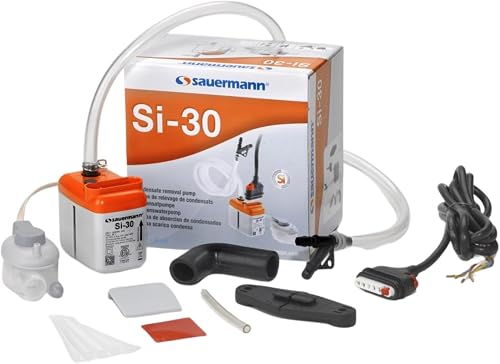 |  |  |  |  |  |  |  |
|---|---|---|---|---|---|---|---|---|---|---|
| Product | Aquastrong Mini Split Pump | Ultra Quiet Condensate Pump | Sauermann Si-30 Pump | WATNOVA Slim Condensate Pump | Ultra-Quiet Condensate Pump | Soft Start Condensate Pump | HVAC Condensate Pump | P16 Mini Split Pump | 95GPH Condensate Pump | Air Mini Split Pump |
| Brand | AQUASTRONG | GuardFlow | Sauermann | WATNOVA | MSKOTOAS | heculy | Cleartide | WIPCOOL | BPSSDI | Knocokie |
| Best for | Best Overall | Best for Bedrooms | Best for Dirty Water | — | Best for High Lifts | Best for Continuous Use | Best for Universal Use | Best for Ductless Systems | Best for High Volume | Best for Pipe Jackets |
| The listing says | 9.6 GPH flow, 33ft head, 20 dB noise Safety switch triggers alarm or shutoff | 16dB noise with soft-start technology Capacitive sensor replaces float mechanism | 5 GPH flow, 33 ft lift, 10 ft suction 20 dBA noise with anti-vibration bracket | Slim design for hidden installation Floatless probe sensor technology | 25 dB noise at 3FT distance Slim design with 3 indicator lights | Efficient condensate removal Compact space-saving design | 10.6 GPH flow, 33ft head Separated reservoir and motor | Designed for fan coil and ducted systems 4.2 GPH flow, 33 ft head | 95GPH flow, 19.6 ft lift Integrated automatic overflow safety switch | Ultra-thin shape, under 19dB(A) noise Includes tubes, velcro, and cable ties |
| More information | Check Price on Amazon | Check Price on Amazon | Check Price on Amazon | Check Price on Amazon | Check Price on Amazon | Check Price on Amazon | Check Price on Amazon | Check Price on Amazon | Check Price on Amazon | Check Price on Amazon |
1. Aquastrong Mini Split HVAC Condensate Pump
Best for: General residential and light commercial HVAC systems.
This pump features a thermally protected motor that manages up to 9.6 GPH, making it a robust choice for standard mini splits. Its inclusion of an automatic safety switch allows you to wire it directly to your AC unit to prevent overflow. If you want the pump to shut off the appliance during a flood, connect the NC and COM wires. Use the NO and COM wires if you prefer to trigger an external alarm instead.
The design uses anti-vibration velcro strips, which helps keep the installation quiet and secure within line set covers. You must install the reservoir vertically with the magnet facing upward to ensure the internal hall switch functions correctly. If the pump fails to engage, check that the magnet is positioned properly.
The unit is easy to maintain because the tank and filter are removable for regular cleaning. You should clean the reservoir, float, and filter at least every six months to prevent clogging. It isn’t for users who need to move water over 33 feet, as that’s the maximum limit for this specific hardware.
Pros
- High 9.6 GPH flow rate
- Includes safety switch for protection
- Easy-to-clean removable tank
Cons
- 33-foot lift limit
- Requires regular six-month cleaning
2. Ultra Quiet Condensate Pump
Best for: High-lift installations in bedrooms or home offices.
It uses an advanced capacitive sensor rather than a mechanical float, which prevents the sensor from sticking.
The universal voltage support makes it highly versatile for different electrical environments. The GuardFlow pump uses capacitive sensor technology, while the Sauermann Si-30 Pump uses piston technology. Use this pump if your system requires vertical drainage through ceilings or long runs where gravity is insufficient. If your installation space is tight, the compact 6.45-inch frame allows for discreet under-mount placement.
It isn’t for DIYers who are uncomfortable with professional wiring, as the manufacturer recommends expert installation to ensure local codes are met. Failing to follow these specific installation guidelines can compromise the 3A safety overflow switch, which is designed to shut down the AC unit to prevent water damage.
Pros
- Impressive 65.6 ft lift
- Ultra-quiet 16 dB operation
- Durable capacitive sensor technology
Cons
- Professional installation recommended
- More complex setup process
3. Sauermann Si-30 Mini Condensate Removal Pump
Best for: Professional-grade reliability in larger HVAC systems.
This pump is built for systems up to 5.6 tons, handling dirty condensate better than many other models due to its patented piston technology. It includes a specific “Drain Safe Device” that retains the pump’s prime to extend its overall service life. The anti-vibration bracket is a smart addition that limits noise transfer to walls or pipes.
Install this unit if your system requires a 33-foot maximum lift or a 10-foot suction head. If your installation space is tight, keep in mind the 2.6 x 1.8 x 2.4-inch dimensions. Because it operates at 20 dBA, you can mount it near living spaces without noise concerns.
It’s designed to be installed above the unit, keeping the pump out of sight. While the WATNOVA Slim Condensate Pump is thinner and better for hidden wall-mounts, this unit is built for durability under heavy loads. It isn’t for small, low-capacity systems where such heavy-duty piston power might be overkill. Always verify your power supply, as this model requires a 230V connection.
Pros
- Handles small particles well
- 5.6-ton system capacity
- Includes anti-vibration wall bracket
Cons
- 5 GPH flow is lower
- Specific to 230V systems
4. WATNOVA Slim Mini Split Condensate Pump
Best for: Hidden, space-sensitive wall-mounted installations.
This pump features a slim design intended to hide behind wall-mounted AC units or inside line set covers. It uses a floatless probe sensor, which avoids the mechanical blockage issues that often plague traditional float switches. With a 19 dB noise rating, it remains very quiet during operation.
If you’re installing in a high-traffic living area, the near-silent operation prevents the audible cycling common with mechanical switches. When mounting, ensure the probe is clear of debris to maintain the accuracy of the water level detection.
The overflow protection is integrated, allowing you to shut down your AC unit if the pump stops draining properly. Connect this to the NC signal line to protect your floors, walls, and ceilings from water damage. If the system fails to drain, the pump interrupts the power to prevent an overflow.
This model is designed for smaller, standard residential units. It isn’t for users who need massive flow rates, as the 4.75 GPH capacity is calibrated for typical ductless systems. To maintain performance, clean the tank and filter every 3–6 months. This simple habit prevents the buildup that leads to premature pump failure.
Pros
- Extremely slim, hidden profile
- Floatless probe sensor technology
- Very quiet operation
Cons
- 4.75 GPH flow capacity
- Not for high-volume commercial systems
5. Ultra-Quiet Condensate Pump
Best for: Extreme vertical head heights.
This model features a remarkable 110-foot vertical lift, which is the highest in this group. It uses a diaphragm pump filled with adhesive to minimize vibration, keeping noise under 25 dB when measured at a 3-foot distance. At this level, the sound is typically masked by the ambient wind of the air conditioner itself. The inclusion of three indicator lights makes it easy to monitor the pump’s operational status at a glance.
The slim body is designed to look aesthetically pleasing if left visible, though it works just as well tucked away. If you’re installing this for a system under 30kw, ensure the horizontal distance doesn’t exceed 350 feet to maintain flow. While the P16 Mini Split Pump offers a much quieter experience, this unit is the clear winner for difficult drainage paths.
The 110-foot lift capacity is unnecessary for most standard residential installations.
Pros
- Massive 110 ft vertical lift
- Useful status indicator lights
- Slim, durable casing
Cons
- Higher noise than other picks
- Overpowered for small systems
6. Soft Start Condensate Pump
Best for: Users prioritizing silent operation.
This pump uses soft-start technology to ensure the motor doesn’t vibrate or hum loudly when it kicks on. It’s designed to be compact, making it a straightforward choice for tight installation areas where space is at a premium. The setup process is simple, allowing for quick connection to most standard mini split systems.
If your primary goal is preventing water damage, this unit handles continuous drainage reliably. It keeps your system free of standing water without the complexity of more advanced sensors.
Choose this model if you value a quiet, set-it-and-forget-it installation. If you require detailed diagnostics or LED status feedback, look elsewhere. This pump intentionally avoids complex electronics to maintain its minimal, space-saving footprint. By focusing on essential condensate removal, it avoids the common mistake of over-complicating a simple drainage task, which often leads to unnecessary maintenance headaches.
Pros
- Very quiet start-up
- Compact, space-saving build
- Simple to install
Cons
- Fewer diagnostic features
- Basic sensor mechanism
7. HVAC Condensate Pump
Best for: Universal compatibility across various appliances.
This pump works with a wide range of devices, including ice makers, furnaces, and dehumidifiers, in addition to AC units. Its hall switch design ensures consistent, automatic operation over a long lifespan. The kit comes with everything needed for a quick setup, including various tube adapters and cable ties.
The reservoir is separated from the motor, which is a great way to save space in tight ceilings or wall cassettes. While the WATNOVA Slim Condensate Pump is more specialized for wall units, this pump is more flexible for multi-appliance use. It isn’t for users who need a single, all-in-one block, as the separated design requires a bit more planning during installation.
If you’re installing in a living area or bedroom, the 23db noise level ensures near-silent operation. Use the provided anti-vibration velcro strips to secure the components within line set covers or wall cassettes. If you notice the reservoir filling, remember that the visible tank is removable for timely cleaning. Always connect the overflow safety switch signal wire; this ensures the system shuts down automatically if an overflow occurs, protecting your floors from water damage.
Pros
- Highly versatile compatibility
- Separated motor and reservoir
- Complete installation kit included
Cons
- Requires space for two parts
- 10.6 GPH limit
8. P16 Mini Split HVAC Condensate Pump
Best for: Ductless systems and fan coils.
This pump is specifically engineered for ducted and fan coil HVAC systems, offering a quiet 19 dB performance. Its probe overflow protection is highly reliable, sending a signal to your control system if water levels get too high. The compact size is perfect for the limited space often found in ceiling voids or small service closets.
It provides a solid 4.2 GPH flow, which is sufficient for most residential ductless setups. While the Ultra-Quiet Condensate Pump (MSKOTOAS) is better for high-lift needs, this unit is much easier to manage in tight ceiling spaces. It isn’t for users who have large-scale commercial HVAC systems, as the lower flow rate may not keep up with high condensation volumes.
If your installation involves a 33 ft discharge head, this pump remains capable of handling the vertical lift. However, you must verify that your system’s condensation volume doesn’t exceed the 4.2 GPH limit to avoid backups.
For best long-term performance, clean the pump tank, float, and filter basket on a regular seasonal basis. Neglecting this maintenance schedule can lead to debris buildup, which often causes premature pump failure.
Pros
- Excellent for ducted systems
- Very quiet 19 dB operation
- Reliable probe sensor
Cons
- Lower 4.2 GPH flow
- Limited to residential usage
9. 95GPH Condensate Pump with 19.6ft Lift
Best for: High-volume drainage requirements.
With a 95 GPH flow rate, this pump is designed for scenarios where water removal must be fast and consistent. It manages a 19.6-foot lift, which is adequate for most residential and light commercial layouts where gravity drainage is unavailable. The integrated safety switch provides the necessary protection against leaks by activating high-water protection when the reservoir reaches a preset level, keeping your floors and walls safe from overflow.
The 29 dB noise level is engineered for low-noise performance, making it suitable for utility rooms, basements, or offices. If you’re installing this in a quiet bedroom or a small, enclosed closet where sound echoes, the motor’s operation may become noticeable. For those spaces, prioritize units with lower decibel ratings.
Use this pump when you need to move condensate to elevated drain locations. If your system requires a lift exceeding 19.6 feet, this unit won’t be sufficient. Always confirm your total vertical lift requirements before installation to ensure the motor can maintain stable system operation.
Pros
- High 95 GPH flow rate
- Strong safety switch protection
- Good for light commercial use
Cons
- Louder than ultra-quiet options
- Limited to a 19.6-foot lift
10. Air Mini 100-240V Split Condensate Pump
Best for: Minimalist installations with anti-siphon needs.
This pump features an ultra-thin design that fits perfectly within pipe jackets or evaporators. It includes an anti-siphon valve, which is a key feature for preventing water from flowing backward into the unit. The quiet operation (<19 dB) makes it a great choice for living rooms or home offices.
It’s fully enclosed and electronic, which protects it from the dust and debris often found in HVAC units. While the Ultra-Quiet Condensate Pump (GuardFlow) offers a much higher lift, this model is superior for tight, internal mounting. It isn’t for users who need to push water up more than 20 meters, as the performance is optimized for shorter, horizontal runs.
Pros
- Includes anti-siphon valve
- Extremely thin 34mm profile
- Very quiet operation
Cons
- 20m max lift limit
- Specialized for internal mounting
The FUJIWARA Removal Mini Quiet Pump is another strong contender for 1-5HP systems, offering a simple automatic drain solution. For those needing a balance of size and silence, the Compact Mini Split Condensate Pump is worth a look. Lastly, the WATNOVA Split HVAC Condensate Pump provides a solid mid-range option with a 33ft lift for those who want a reliable, standard-sized pump.
How to Choose in Sixty Seconds
Lift Height Requirements
Measure the vertical distance from your AC drain pan to the highest point the drain line must reach. If the water needs to travel up a wall or into a ceiling, you must pick a pump with a “max lift” or “head” rating higher than your measurement. Always check the manufacturer’s Underwriters Laboratories safety certification, as this ensures the pump meets rigorous electrical standards for water-handling equipment in the US. Overestimating your lift needs is safer than underestimating, as it keeps the motor from working at its maximum capacity, which can help extend the life of the pump.
Sensor Technology
Choose between mechanical float switches and electronic probe sensors. Mechanical floats are the traditional choice and are easy to understand, but they can sometimes stick if the water is dirty or contains algae. Probe sensors are “floatless” and use digital water level detection, which reduces mechanical failure. If you live in an area with high humidity or where your AC runs constantly, a probe sensor is often more reliable over the long term. However, mechanical floats are often easier to troubleshoot if you’re doing the maintenance yourself.
Noise Sensitivity
If your mini split is in a bedroom or a quiet home office, noise level is the most important factor. Look for pumps rated at 19 dB or lower. Many of these units use “soft-start” technology, which prevents the pump from vibrating loudly when it cycles on. If the pump is going into a basement or a utility room, a slightly louder pump—around 25 to 29 dB—will likely be perfectly fine and won’t be noticeable. Always consider where the pump will be mounted; if it’s mounted directly to a hollow wall, even a quiet pump can vibrate and create noise. Use the included anti-vibration pads or velcro strips to isolate the unit from the wall.
Frequently Asked Questions
Can I install these pumps myself?
Most of these pumps are designed for DIY installation if you are comfortable with basic electrical and plumbing work. You must connect the pump’s power supply and safety switch to your AC unit’s control board. If you are unsure about local building codes, hire a professional to ensure the safety switch is wired correctly.
How often do I need to clean the pump?
You should clean the reservoir, float, and filter as part of your routine preventative maintenance. Algae and dust can build up in the drain pan, which may cause the pump to fail or overflow. Always turn off the power to the AC unit before opening the reservoir for cleaning.
What happens if the pump fails?
The integrated safety switch automatically shuts down your AC unit if the pump stops working to prevent water damage. Many models include LED diagnostic lights to help identify drainage issues. If the pump fails, check for clogs in the filter or drain line and ensure the safety switch is properly connected.
Does the pump need to be level?
Most pumps require the reservoir to be installed perfectly level for the sensor to detect water correctly. If the reservoir is tilted, the sensor may not trigger, causing the pump to run dry or fail to activate. Use a bubble level during installation to ensure the reservoir is mounted horizontally.
Closing
For most residential needs, the Aquastrong Mini Split Pump remains the top choice due to its balance of safety and ease of maintenance. If your installation requires a significant vertical lift, the Ultra-Quiet Condensate Pump is the most capable unit in our selection. Before finalizing your purchase, double-check the voltage of your existing HVAC setup to ensure the pump you choose is compatible. Proper installation is key to avoiding overflow, so follow the included drilling templates and ensure your reservoir is level. If you have questions about specific wiring, consult the manual included in your kit or reach out to a professional HVAC technician to ensure your safety switch is connected correctly.